
Smart and sustainable buying
Fly screens for windows and doors – what you need to know

exclusively for nimms.ch
27/03/2026
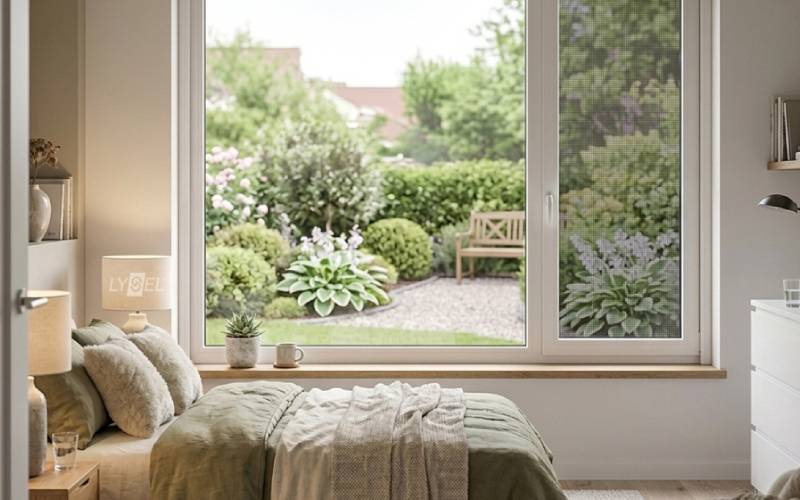
Spring at last! The windows open, fresh air flows in – and unfortunately, so do the first mosquitoes, flies and wasps. No wonder that fly screens are among the most searched-for window products during the warmer months. But there are several things to consider when buying one, because not every insect-protection product is equally good – and some choices that seem inexpensive at first turn out to be costly (and environmentally harmful) mistakes.
In this article, we show you what you should really look for when buying a fly screen, which types are available, how to choose sustainably – and why a high-quality tension frame is the better long-term choice than quick self-adhesive solutions.
What types of fly screens are available?
The market offers a surprisingly wide selection. Depending on the type of window or door and your personal needs, there are many different solutions:
- Fly screens in a tension frame (aluminium): Ready-made or custom-made aluminium frames that are fitted into the window or secured with clamp holders. Robust and durable.
- Self-adhesive tension frames / adhesive mesh: Fly-screen mesh with an adhesive-tape frame that is stuck directly to the window. Easy to install – but with significant drawbacks.
- Roller fly screens: Roll-up systems mounted at the side or top of the window frame. Convenient, but more expensive.
- Pleated fly screens: A foldable option that is particularly elegant and space-saving. Well suited to doors and large openings.
- Insect-screen doors: Magnetic closures or framed doors designed specifically for entrance doors or patio doors.
- Freely tensioned mesh: Simple fly-screen mesh secured without a rigid frame using magnets or hook-and-loop fasteners.

Good to know
The mesh size determines what stays outside. For mosquitoes, a mesh size of 1.0–1.2 mm is sufficient. Anyone who also wants to keep pollen out of the home (ideal for allergy sufferers!) should choose a special pollen-protection mesh with a finer mesh size.
Adhesive tape vs. tension frame: a direct comparison
You may know the situation: large DIY stores tempt customers with self-adhesive fly-screen kits at attractively low prices. Brands such as tesa offer these products – the mesh is simply stretched across the window and secured with an adhesive frame. It sounds practical. But how well does it really perform in everyday use?
| Criterion | Adhesive mesh | Tension frame (aluminium) |
|---|---|---|
| Service life | approx. 1 summer | approx. 20 years |
| Mesh quality | Mesh deteriorates after one season | Stable, weather-resistant fibreglass or aluminium mesh |
| Adhesive tape / adhesion | Adhesive residue on the window; comes loose over time | No adhesives; clamps or clicks into place |
| Removal | Time-consuming and leaves residue | Installed and removed in seconds |
| Sustainability | Buying a new one every year = lots of plastic waste | One-time investment, usable for decades |
| Purchase cost | Low (approx. CHF 5–15 per window) | Somewhat higher, but worthwhile in the long run |
| Total cost over 10 years | High (10× repurchase) | Low (one-time investment) |
| Fit | Limited | Can be adjusted precisely to custom dimensions |
| Appearance | Visible adhesive seams, not very attractive | Clean, simple design |
Be careful with adhesive mesh
Many buyers report that self-adhesive meshes, such as the well-known tesa Insect Stop, become brittle after just one summer and the mesh tears. The adhesive tape also leaves residue on the window frame that is difficult to remove. What looked like a bargain can quickly become a frustrating purchase.
Why your purchase decision is also an environmental decision
This is where an aspect comes into play that people rarely consider when buying a fly screen – but should: sustainability.
Self-adhesive fly screens made of plastic mesh end up in the rubbish after a single summer. Keep in mind: the mesh consists of plastic fibres, and the adhesive frame is made from mixed plastics – both are difficult to recycle. If you buy a new set every year for five windows, the waste adds up to a considerable amount over ten years. A true zero-waste nightmare.
A Lysel fly screen in an aluminium tension frame, on the other hand, has a life cycle of around 20 years – roughly as long as a modern plastic window itself. This is not a marketing promise, but a result of the material properties: aluminium is weather-resistant, corrosion-resistant and does not change shape in heat or cold. The frame is made once, installed once and stays in place.
Sustainability at a glance
An aluminium tension frame replaces up to 20 adhesive fly screens from the same season
Aluminium is one of the most recyclable materials of all – at the end of its useful life, the frame can be completely melted down
No adhesive = no chemical residue on the window or in the environment
Anyone who passes the frame on after many years extends its life cycle even further
That is upcycling in the literal sense: buy well once, use it for a long time, and pass it on. Instead of producing new plastic waste every few months.
What should you look for when buying? – The most important criteria
1. Take accurate measurements
Before you order or go to the DIY store: measure the window! The clear opening (the distance from the inside edge of one frame to the inside edge of the other) is crucial. Many suppliers make frames to measure – it costs hardly any more, but gives a perfect fit.
Tip: take measurements correctly:
- Measure in at least three places (top, middle, bottom or left, middle, right) – window frames are often not perfectly rectangular. Use the smallest measurement as the basis to make sure the screen fits.
2. Choose the type of mesh
This depends on your priorities:
- Standard fly-screen mesh (fibreglass, grey): Affordable, proven and offers very good visibility through the screen.
- Pollen-protection mesh: Finer mesh, ideal for allergy sufferers. Slightly restricts air circulation.
- Aluminium mesh: Particularly strong, ideal if pets or children put strain on the screen.
- Black mesh: Reduces light reflection and improves the view outside.
3. Choose the mounting method
There are different installation methods depending on the type of window:
- Clamping in place (tension frame): The frame is held in place by tension – no drilling required.
- Clamp holders: Small plastic or metal holders clamp the frame into the rebate.
- Screw mounting: More permanent, but requires small drill holes.
- Magnetic: Easy to remove, but less resistant to wind.
4. Frame material
Aluminium is the clearly recommended choice: lightweight, stable, weather-resistant and recyclable. Plastic frames are cheaper, but become brittle over time and can warp in heat.
Fly screens for doors – what is different?
Doors – especially balcony and patio doors – have different requirements from windows. Easy passage is important here: you want to be able to go into the garden without having to remove the screen completely every time.
Proven solutions for doors include:
- Pleated doors: Foldable and can be pushed to the side like a curtain. Very convenient.
- Roller doors: Similar, but roll upwards. Space-saving.
- Magnetic curtains: Simple strips of mesh that close automatically after you walk through. Affordable and suitable for basic use.
- Framed hinged doors: Permanently installed door frames with their own opening mechanism. The highest-quality (and most expensive) solution.
What should you do with an old fly screen?
Perhaps you still have an old adhesive mesh at home – or a frame from previous years. Before everything ends up in the rubbish, it is worth taking another look:
- Pass it on for reuse: Does your fly screen still work, but no longer fit your new window? It may fit someone else's perfectly, and you can give it away!
- Use old frames as plant supports: Aluminium frames with fly-screen mesh can be reused wonderfully as climbing supports for tomatoes or beans in the garden.
- Use the mesh as protective netting: Fine-mesh fly-screen material can be used to protect raised beds against insects or as a cover for cold frames.
- Use mesh offcuts as seed bags: Small pieces of fly-screen mesh sewn together make compact little bags for storing seeds.
The zero-waste idea
Before you throw something away, ask: could someone else use it? That is the simplest form of a circular economy. Platforms such as nimms.ch were created for exactly this purpose – so that things do not end up in the rubbish, but get a new life.
Our recommendation: how to buy smart
1. Take measurements – at three points, note the smallest value
2. Choose an aluminium frame – durable, recyclable and adhesive-free
3. Choose the right type of mesh – for pollen allergies: fine pollen-protection mesh
4. Order made to measure – it is worth it; a precise fit is everything
5. Consider doors separately – a pleated screen is often the more convenient solution here
6. Do not simply throw away the old screen – pass it on, upcycle it or dispose of it properly
Anyone who invests a little more today and chooses an aluminium fly-screen frame is doing both themselves and the environment a favour. A 20-year service life, no adhesive, no special waste, and a reliable solution summer after summer. That is what we call buying smart.
Do you currently have an old fly screen that you no longer need? Give it away for free on nimms.ch! Someone near you may be looking for exactly that.
Thanks for reading.
exclusively for nimms.ch
27/03/2026
Would you like to contribute something? Get in touch with us.
Learn more about us on our About Us page.